
Victoria had always assumed there would come a moment when the logic of her decisions, the linear cause-and-effect of each mistake and impulse, would reveal itself as a single clear line in retrospect. But the compound days of her existence, the small hungers and larger fears, bled together so that she could never distinguish which misstep had truly set her here, alone and unmoored. She liked to imagine the act of tracing her life backwards, as if any one choice could have interrupted the sequence and set her free. There were games she played to pass the empty hours, mind games where she imagined herself stepping off the path at the right moment: refusing a hand, saying no, looking away. The game was cruel in its simplicity, and always ended the same. If she tried to imagine a moment before she had been marked by mistake, before the first regret, she always landed here, now, in the vastness of the chapel’s upper rooms, left in silence.From the moment of her birth, the world had been circumscribed by the ballet. She was born upstairs at the chapel, her mother a dancer in the lowest tier, a girl with no family and too much hope, who had taken to spinning tales for the other girls even as she spun herself into a prison of repetition. Victoria had watched her mother’s dances from the wings: at first, she remembered the beauty of it, the way impossible things happened with the body, the grace and the fever of the stage. Her mother had been the first to teach her positions, to pull her little arms into the correct shape, to reward her with a piece of chocolate if she could turn out her feet. At five, Victoria could already mimic the older girls, balancing on the tips of her toes for a heartbeat before collapsing and laughing, a high, startled sound that echoed in the empty studio. She had wanted to be her mother, to carry the lightness and the ache of dance. She had wanted to be beloved by someone, anyone.The reality of the ballet revealed itself in increments, like light spreading in a dark room. The older girls were beautiful and cold, vanishing after certain performances and reappearing with expensive gifts and bruises. The men who came backstage were always tipped in shadow, smelling of tobacco and sweet aftershave, watching the girls with a hunger that was never about the dance. The choreographer took lunch with the Salvatore family, received sealed envelopes, and distributed them to the girls with names circled in red. Victoria saw it all and said nothing, because silence had been the first thing she learned from her mother.The terror began when she was eleven. She had been training en pointe for only a few months, and already her toes were strange and swollen, the nails blackened. Her hair was so long she could sit on it, a river of darkness down her back. She remembered the day perfectly: a gray morning, the city’s church bells muffled by fog, the ballet studio cold enough to see her breath if she exhaled close to the mirror. Her mother was pinning her hair, fingers trembling as she wove it into a tight bun, and Victoria watched both of their faces in the reflection: hers, round and soft; her mother’s, sharper now, almost hollow. Her mother’s eyes were rimmed in red, the skin underneath almost purple, and Victoria wondered exactly when the exhaustion had set in, when she had started to sleep alone in the narrow cot. She wanted to ask, but when she opened her mouth the words vanished, replaced by a sudden need to bury her face in her mother’s lap and stay there forever.The moment was shattered by the door slamming open, the sound so abrupt even her mother flinched. “Marie,” the man’s voice called. Not a question, but a command. Victoria’s mother kissed the top of her head and whispered, “Don’t move, darling,” before stepping away with the forced elegance of a dancer on stage. The door closed behind her, and Victoria sat very still, listening to the muffled argument, the sound of something breaking, the thin, animal cry that might have been her mother at all. That was the last time she ever saw her.The weeks after were a sequence of blank spaces: meals eaten in silence, classes attended with robotic precision, the other girls watching with a mixture of pity and relief. Victoria learned to braid her own hair, to tape her toes and smile for the teachers, to ignore the stares from the men who lingered in the lobby after rehearsals. If she grieved, it was in private, and only by refusing to speak about her mother at all.By the time she turned sixteen, Victoria had perfected the performance. She danced at the front of every rehearsal, body always a little sharper, leaner, more desperate for approval. Miss Colette, the ballet mistress, noticed her at once; there was nothing that escaped her, not the way Victoria balanced on pointe for seconds longer than the others, nor the way she never met anyone’s gaze. Colette was the queen of rumor, the regulator of secrets, and she wasted no time reporting to Samuel Salvatore himself when Victoria became too remarkable to ignore.The first time Victoria was summoned to perform for Salvatore alone, it was framed as an honor. She wore a new leotard, navy blue, with a white ribbon at her waist, and Colette painted her lips until her mouth ached from smiling. The man himself was courteous, soft-spoken, with the kind of practiced gentleness that belonged to dangerous men. She danced while he watched, and pretended not to notice when he told her to remove her shoes and pirouette barefoot, or when he had her repeat the same sequence again and again, until sweat ran down her spine and pooled behind her knees. Afterwards, Colette praised her, gave her a small glass of port to drink, and told her that the best girls always attracted attention. Victoria was not sure if she was supposed to feel proud, but she nodded and practiced even harder.Now, at seventeen, Victoria felt the currents of her world as intimately as she felt the pulse in her feet. She knew which girls would be chosen for performance nights, which guests would arrive early to watch the rehearsals, which gifts would be left in the dressing rooms, and which debts would be paid with the bodies of the dancers. The Salvatore family owned everything, from the chandeliers in the concert hall to the flesh and blood of the girls themselves. No one even pretended otherwise.On the morning of the next audition, Colette gathered the girls in the concert hall before dawn. The cold was immense, hovering in the air like a dare. Victoria stretched behind the velvet curtain, joined by Elise, who had always been the only other girl to match her for silence. Elise was new to pointe, and her father’s gambling debts had landed her here without warning; she was thin in a way that looked painful, with wrists like blades. Together, they watched the other girls stretch and gossip, the nervous energy of the morning sparking and snapping in the dim light.The ritual was always the same: the doors would open, the music would stop, and the men would file into the room as if they were kings surveying their harem. Victoria had learned to keep her head down, but today, curiosity won out. She risked a glance through the gap in the curtain and saw Samuel Salvatore flanked by two men, one younger and beautiful, the other older, with a face carved like an ancient coin. She looked away quickly, but not before the younger man’s eyes caught hers. He smiled, slow and deliberate, and she felt her stomach twist.Elise squeezed her hand. “Don’t,” she whispered. “If you look at them, they remember you.” Victoria knew this was true; she had learned that Salvatore only liked a girl to be bold if he could be the one to break her.Colette’s voice boomed from the stage, rehearsed and honeyed, “Monsieur Salvatore, what a pleasure.” She gestured to the girls behind her, a silent roll call of body types and hair colors, and the men took their seats in the center of the hall. For a moment, everything was suspended. Then, with a clatter of her heels, Colette descended the stairs and hissed for the girls to take the stage.She called the names with cruel precision: “Elise, Camille, Juliette, Margot, Victoria.” There was always something performative in the way she said them, as if introducing characters in a play. The chosen girls lined up in the wings, shivering and anxious in their thin leotards and pale tights. Victoria smoothed her skirt and tried to calm her breathing. Juliette was beside her, tall and beautiful, with hair the color of moonlight; Margot and Camille were behind them, whispering fast and low, too quick for Victoria to catch more than a word or two.When Victoria finally stepped into the light, the shock of the sudden brightness was like being flayed alive. She felt every eye in the room snap to her; she felt the weight of their wanting. Colette stood at the side, arms folded, her sharp little eyes daring any of the girls to make a mistake. The audience of men arranged themselves with the boredom of practiced cruelty, leaning back in their velvet seats, the better to observe every detail.Victoria’s body responded automatically. Years of practice had carved the motions into her bones: the rising to pointe, the extension of her leg, the reach of her arms. Colette clapped her hands, and the pianist began the overture, notes drifting from the grand piano like snow.Victoria stood at the front, shoulders squared and chin up, with Juliette beside her and the remaining three girls fanned behind them as if they were the wings of a doomed bird. The velvet curtain was drawn, but this was no sanctuary; it was just another stage, and every dancer in the room had learned early that nowhere in the opera house was safe from scrutiny.Colette clapped once, brisk and clean, and the pianist—an ancient man whose name no one bothered to remember—struck the keys with a commanding authority. The opening notes were unhurried, as if the music itself were stretching awake from a long slumber, but the girls had no such luxury. Victoria pushed off the balls of her feet, feeling the hard, cold floor bite into her battered toes. Her muscles cinched tight, strung with the frantic energy of anticipation; even with her eyes closed, she could feel the stares, could sense the unblinking gaze of the men in the front row. She knew that if she dared to look, she’d find Samuel Salvatore already watching her, eyes half-lidded with the languor of someone who’d seen it all and yet wanted more.But Victoria had learned her lessons. She swept her arms up, unfurling them in a perfect arc, letting the air catch at her wrists and fingers. The choreography was muscle memory—pliés, relevés, balances that demanded more of her mind than her body at this point—but beneath the surface, her mind was a wild, thrashing thing. For once, she invited the music to blot out everything else. She let herself be carried by the melody’s gentle currents, using the familiar strain of the score to drown out the clatter of her own heartbeat, to ignore the little voice in her head that counted every second until it was over.Next to her, Juliette danced with the same economy as Victoria—every gesture precise, every movement honed to the lethal sharpness of a knife. The two of them were kept apart by less than a breath. Juliette’s hair, pale as dandelion fluff, floated behind her with every turn; Victoria’s own hair, inky and heavy, was wound into a sleek bun, no nonsense, nothing for the men to comment on. Together, they were matched, almost mirror images, and this symmetry was not an accident. Colette believed in pairs, always, in matching the girls like twins for maximum effect.Behind them, Margot and Camille were less disciplined, more eager to catch the eye, their movements a touch exaggerated. Elise, at the end of the line, was the antithesis: she moved as if each gesture might tear her in half, brittle and desperate, taking up as little space as possible. Victoria wished, for a moment, that she could swap places with Elise, could disappear backstage, could spend the rest of her life avoiding the front row’s scrutiny. But wishing was for girls who had a future. Victoria understood she had only this: the present, the stage, the gaze.The routine unspooled in increments, measured by the piano’s relentless forward motion. There was no room for improvisation, not in Colette’s ballet. Every leap, every landing, had been practiced a thousand times in the upstairs studio, where the windows let in sunlight so cold and sharp it hurt to look at. Victoria’s arms floated into fifth position, her back arching in a perfect arabesque, and she felt the air pass over her skin like a phantom hand. She risked a half-second’s glance at the audience, eyes darting open and closed like a nervous animal.Salvatore was watching, of course. His lips were parted, his tongue just visible as he pressed it against the front of his teeth. The younger man beside him—a new arrival, with the clean, cruel beauty of a soap opera villain—leaned forward, elbows on knees, as if he might spring from his chair at any moment. The older man, the one with the face of a Roman emperor, simply watched her without emotion, as if she were another painting in a vast gallery he owned. Victoria’s stomach twisted, but she did not falter. It wasn’t the attention that bothered her, not anymore; it was the hunger in the room, the sense that every gesture was being weighed as if it were a dowry.The music rose, quickening, a river rushing to its own destruction. Victoria closed her eyes again, this time not out of fear, but defiance. She welcomed the darkness behind her lids, the relief of not-seeing, of being seen but not having to look back. Her body responded as it always did: legs snapping into a series of jetés, arms slicing through the air, breath coming in short, sharp bursts. She felt her muscles trembling, the familiar dull ache in her calves. The pain was a comfort, a reminder that she was still in charge of something, even if it was only the threshold between agony and collapse.Juliette caught her hand on the final pirouette, spinning them both with a calculated grace that drew a collective gasp from the men. For a fleeting moment, Victoria allowed herself to feel proud. They landed together, perfectly synchronized, the ends of their fingertips barely touching. Behind them, Margot and Camille finished a hair late, earning a micro-glare from Colette, and Elise stumbled, just a little, but enough to be noticed.The music plummeted to its conclusion, a few last notes hanging in the air like an echo of possibility. Victoria, standing on pointe, outstretched her arms and stayed there, refusing the urge to collapse into the tired softness of her heels. Her chest heaved, sweat prickling at her hairline. She opened her eyes in time to see Salvatore already applauding—no subtle golf clap here, but a thunderous, possessive ovation that seemed to demand more from her, even then.Victoria fell back gently, letting her weight settle on the balls of her feet. She drew a trembling breath, not daring to look at Colette, who was surely cataloguing every error. Juliette was at her side, her pale face flushed but triumphant, and the other girls filed to the back of the stage, their performance finished but their labor far from over.For a moment, there was a hush. Then Colette’s voice, sharp and ringing, called out, “Merci, mes chéries!” The girls bowed, as required, each one dipping in turn, and Victoria’s mind floated above her body, observing the ritual as if it were happening to someone else. She began to move toward the wing, desperate for the cold backstage air, when the sound of a chair scraping the floor made her freeze.Samuel Salvatore stood, his bulk casting a shadow over the men beside him. He slid a ringed hand over the back of the seat, making the wood groan under his grip. He took two steps toward the stage, then called out, his voice as slick and heavy as the oil paint in the chapel’s murals, “Victoria!” The word hit the air like a command, stopping her in her tracks instantly.
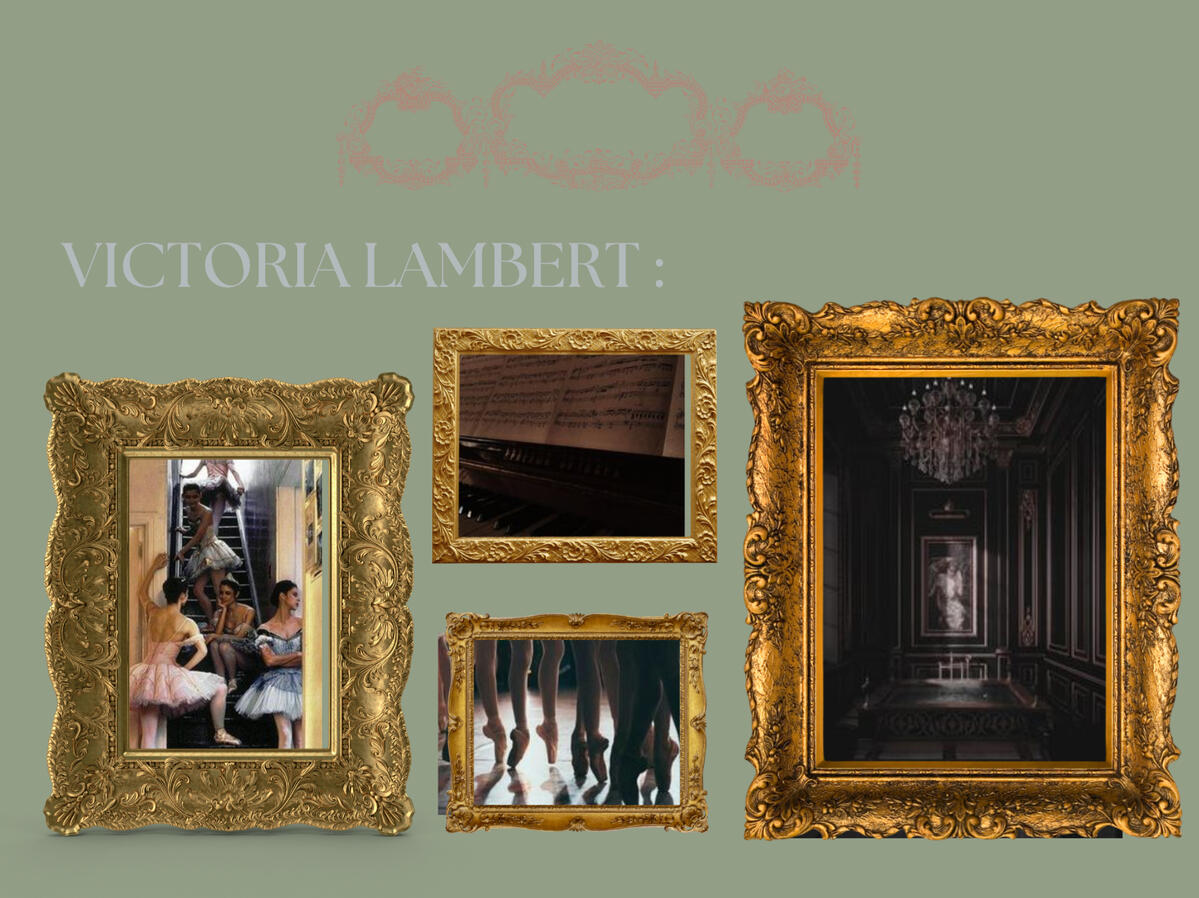
Victoria is small and precise, the kind of woman a room notices before she speaks. She stands at 5'6" but carries herself as though she is deciding, moment to moment, exactly how much space to occupy. Her limbs are long relative to her frame—a dancer's proportions—and her posture has the quality of something trained into the body young and never fully relaxed. Her eyes are a pale, almost colorless green, the kind that can look silver in certain light, set beneath brows that seem permanently arranged into something between focus and suspicion.
The skin beneath them is bruised with sleeplessness, a purplish shadow that her pale complexion does nothing to conceal. Her hair is very dark and falls in loose waves to her waist, and she has the habit of not doing much with it.Her jaw is angular, her chin pointed, her mouth full in a slightly uneven way—the lower lip heavier than the upper, which gives her a look of either sensuality or stubbornness depending on her mood. When she performs, she wears as little as the work demands, and moves with the unsettling ease of someone who has learned to make difficulty look effortless. Off the stage, she disappears into oversized clothes—soft, shapeless things that seem chosen specifically to contradict everything her body does when she dances.She does not trust easily, and the circle of people she trusts at all is very small and consists entirely of her sisters, for whom she would do almost anything without being asked. She has a short threshold for anger and has never learned—or never tried—to put much distance between the feeling and the response. There is something in her that was broken at some point and reset slightly wrong, and she has built considerable strength around it. She watches people the way someone watches a door they are not sure will stay closed. She is quick to read a room and quicker to read a person, and she is intelligent enough to do something with what she finds—to adjust, to mirror, to give someone exactly the version of her they seem to want. Whether this is charm or strategy is not always clear, even to her.